


Institute of Formal and Applied Linguistics
Charles University, Czech Republic
Faculty of Mathematics and Physics
DACT
Chant Analytics
The Digital Analysis of Chant Transmission (DACT) is a Partnership Grant funded by the Social Sciences and Humanities Research Council of Canada (grant no. 895-2023-1002). It aims to extend the study of the dissemination of plainchant from localized research focused mostly on Europe and the Middle Ages to global research tracing transmission to other continents through to the modern era. Understanding how chant traveled and adapted over time and place through oral and written traditions is important for what it can tell us about the communication of culture through the encounters of people and ideas. Yet, data management when dealing with a thousand years of music is a major obstacle. To address this problem, DACT is mobilizing a large network of people and projects to analyse chant repertories digitally and to develop new computational resources in tandem with existing chant databases and digital repositories of manuscripts.
What we have done
First up, we work on resources for computational chant research. We have collected CantusCorpus v1.0: a complete, clean snapshot of both chants and manuscripts available via the Cantus Index interface across its network of 19 interconnected chant databases.
To make using this dataset easy, we provide the PyCantus library. It also includes a set of tutorials showing how to use it to reproduce recent results in computational chant research.
Taking advantage of the independence of CantusCorpus on any specific user interface, we have been developing also some chant analysis applications:
ChantLab, which automatically creates optimal synoptic views for arbitrary sets of melodies using multiple sequence alignment algorithms from bioinformatics, and also exports multiple analytical outputs: a similarity matrix, a hierarchical clustering, and it can experimentally also compute phylogenetic trees mapping chant melody transmission. (Note that the first "encounter" will be slow, because ChantLab is loading all 888.000 chants in CantusCorpus v1.0...)
ChantMapper, which allows exploring traditions in repertoire across all the manuscripts: imagine the Cantus Analysis Tool, but with a map, and with the ability to also inspect "soft" traditions that allow some slight variability in repertoire choices inside.
We have also experimented with memory-efficient segmentation of chant melodies, estimating the number of unseen chants, probabilistic reconstruction of ancestral melodies (and deconstructing the melodies of Solesmes a little bit in the process), and more. By the way, we also have state-of-the-art end-to-end Optical Music Recognition for chant notation!
The Team
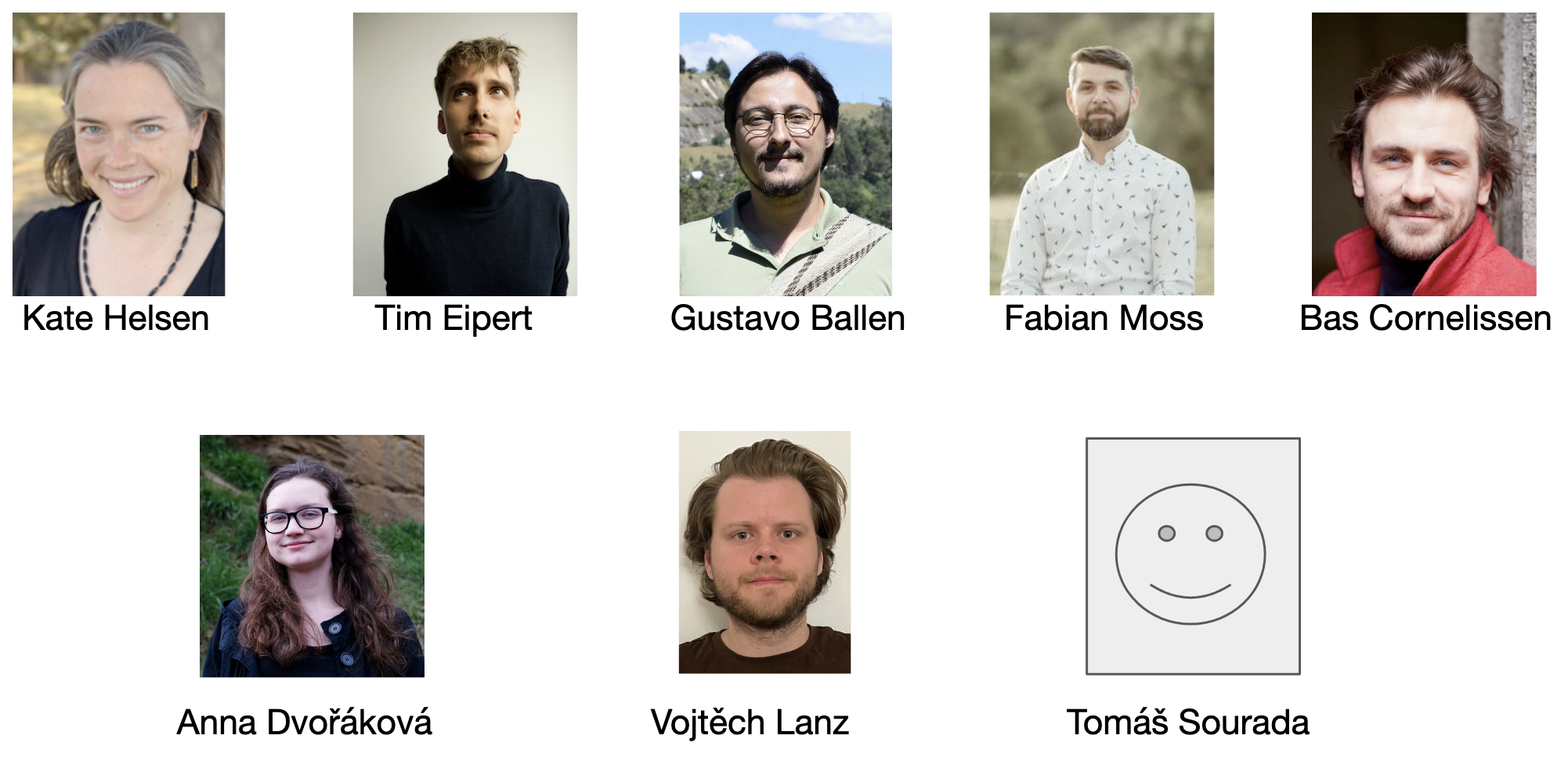
UFAL is the host institution for the Chant Analytics team, which is led by Jan Hajič jr. The team is developing computational tools for the study of chant transmission, both of melody and repertoire, and doing research using these tools, especially to evaluate their effectiveness and accuracy. The team members are:
Prof. Mark Daley
And the student team members at UFAL (who are in fact doing most of the work!) are Mgr. Vojtěch Lanz and Bc. Anna Dvořáková, with hope that they will be joined by Bc. Tomáš Sourada.
The Faces of Chant Analytics
News
2026-09-01 Anna Dvořáková is going to represent chant analytics in Cantus Planus in Evora on Friday, with a talk about CantusCorpus v1.0 and the PyCantus library, what it means for computational chant research, and ongoing work on CantusCorpus v2.0. Fingers crossed!
2026-08-16 The ChantLab software has been updated to use CantusCorpus v1.0, and to export the alignments to PNG images.
2026-06-10 The work of Daniel Kurek on a universal model for optical recognition of diastematic chant notations has been accepted to the WoRMS workshop - which is a full-scale publication this year, as WoRMS 2026 has become an official workshop of the ICDAR conference. Congratulations!
2026-05-29 The paper "What did the dove sing to Pope Gregory? Ancestral melody reconstruction in Gregorian chant using Bayesian phylogenetics" has been published in PLoS One! We take the methodology of chant melody phylogenetics a step further and estimate ancestral melodies at all common ancestors in the Christmas dataset. We also see how the modern melodies of Solesmes fit into the picture: they don't, to a surprising extent, though they seem to have most in common with the 12th century Cistercian redaction. Many thanks to Gustavo A. Ballen for taking the lead on this one!
2026-03-12 The PyCantus library, and even more importantly the CantusCorpus v1.0 dataset, are finished -- and a paper about it has been accepted to the TISMIR special issue on digital musicology! Congratulations to Anna, who was the unstoppable driving force behind this thing, and thank you to Tim Eipert and Debra Lacoste for their help. Actually, thanks to Tim, we have been able to harmonise a bit of Corpus Monodicum into the same format, so hopefully PyCantus will become useful also beyond the Cantus data ecosystem.
2025-12-04: The Genome of Melody paper is finally out in the RSTB journal, special issue on Cultural Evolution. TL;DR: Phylogenetic methods are a viable alternative to manual melodic analysis for researching melodic dialects of Gregorian chant and the transmission of chant melody across medieval Europe. This is the first computational study of chant transmission with evolutionary methods -- and it turns out chant can very much be modelled in a similar way, thanks to how it was transmitted from one "generation" of practitioners to the next.
2025-09-27: Back from ISMIR and DLfM in Korea. DACT was represented by one paper at ISMIR and one at DLfM. The ISMIR paper brought a convincing argument against centonization, at least surface-level, but at the same time provided an empirical proof of the link between modality and memory: the more memory-efficient a segmentation is, the better it can be used to predict mode, so the idea of mode as a method primarily for organising melodies in memory and learning them, rather than a music-theoretical construction, now has a data-driven argument in support.
At DLfM, in collaboration with Fabian Moss, we probed how much of chant repertoire has already been catalogued in the Cantus Database using Unseen Species Models borrowed from ecology. It turns out we still have a lot of cataloguing to do: the Cantus database contains at most 57 % of all the distinct chants that comprised the medieval repertoire of the entire continent.
We also want to thank the ISMIR general chairs from KAIST and Sogang University (Juhan Nam, Dasaem Jeong, and Keunwoo Choi), the programme chairs and various other committee members, and the more than 60 volunteers for an absolutely fantastic conference. Besides a strong scientific programme it involved by far the most impressive traditional music performance I have ever seen (the group is called BARAJI, they have recordings on soundcloud, check them out), a perfectly organised jam session (and that is *not* easy), K-Culture night, and so much more...
2025-02-28 The PyCantus library, first planned out at the DACT Chant Analytics workshop in Prague, has started development in the capable hands of Anna Dvořáková. If you have any plans for working with chant computationally... watch this space.
2025-03-14 We presented the ChantMapper and ChantLab apps to the broader DACT community. Happy to say both live demos went fine. (Addendum: I learned recently that also Emma Hornby's group in Bristol has been playing around with ChantLab recently, and it also didn't crash with 4 people working on it in parallel... so it may actually have become rather stable software, after 4 years of intermittent development.)
2025-02-14 ChantMapper and ChantLab accepted to the Music Encoding Conference 2025! Congratulations to both Vojtěch and Anna (especially Anna, for whom this marks her first publication, and having published the results from her Bc. thesis). We hope to see many members of the digital musicology community at MEC.
2024-09-10 Congratulations to Anna Dvořáková on successfully defending her Bachelor thesis on the subject of mapping and clustering Gregorian sources! (Thesis is in Czech, though.)
2024-06-06 A DACT Chant Analytics workshop took place in Prague, with Kate Helsen participating remotely and Tim Eipert in person.
2024-04-06 It was terribly exciting to meet so much of our DACT colleagues in person at the 18th Workshop in Halifax! Learning about chant in Mexico City and its Chinese redactions was absolutely fascinating. This is what I love about working in the digital humanities: there is always more to learn about the world. Check out the Vincent Lebbe Chinese edition of chant on YouTube.
2023-11-10 A pleasure, as always, to present at the DLfM conference co-located with ISMIR 2025 in Milan. We showed that contrary to previous results, text boundaries actually do not lead to a segmentation of melody that better characterises mode in Gregorian antiphons.
2023-11-08 Waves have been made at ISMIR with a paper on phylogenetic trees and chant melody. We got spotlighted (thanks, Uri)!
Partners
The DACT project has the following partners:
- Dalhousie University, Halifax, Nova Scotia, Canada [Host Institution]
- ACENET, Supercomputing in Atlantic Canada
- Bodleian Libraries, University of Oxford, UK
- Cape Breton University, Sydney, Nova Scotia, Canada
- Hill Museum and Manuscript Library, Collegeville, Minnesota, USA
- Hungarian Academy of Sciences, Budapest, Hungary, Research Centre for the Humanities, Institute for Musicology
- McGill University, Montréal, Québec, Canada, Schulich School of Music
- Mount Allison University, Sackville, New Brunswick, Canada
- Polish Academy of Sciences, Warszawa, Poland, Institute of Art
- RISM Digital Center, Bern, Switzerland
- Slovak Academy of Sciences, Institute of Musicology, Bratislava, Slovakia
- Unama'ki College, Sydney, Nova Scotia, Canada
- Universidad Complutense de Madrid, Spain, Musica Hispanica / Spanish Early Music Manuscripts
- Universidade NOVA de Lisboa, Faculdade de Ciências Sociais e Humanas, Lisbon, Portugal, Centro de Estudos de Sociologia e Estética Musical, (Centre for the Study of the Sociology and Aesthetics of Music CESEM)
- Université de Fribourg, Switzerland, e-codices, Fragmentarium
- University of Manitoba, Winnipeg, Manitoba, Canada
- University of Missouri-Kansas City, USA, CODICES: Digital Humanities Lab
- University of Oslo, Norway, BENEDICAMUS project
- University of Oxford, UK, DIAMM (the Digital Image Archive of Medieval Music)
- University of Waterloo, Ontario, Canada, Cantus: A Database for Latin Ecclesiastical Chant
- Wilfrid Laurier University, Waterloo, Ontario, Canada